
Cerebellum Exercises for ADHD: 8 Moves and the Evidence
Eight balance, coordination and timing drills that work the cerebellum, a 10-minute routine, and an honest look at whether they help ADHD.
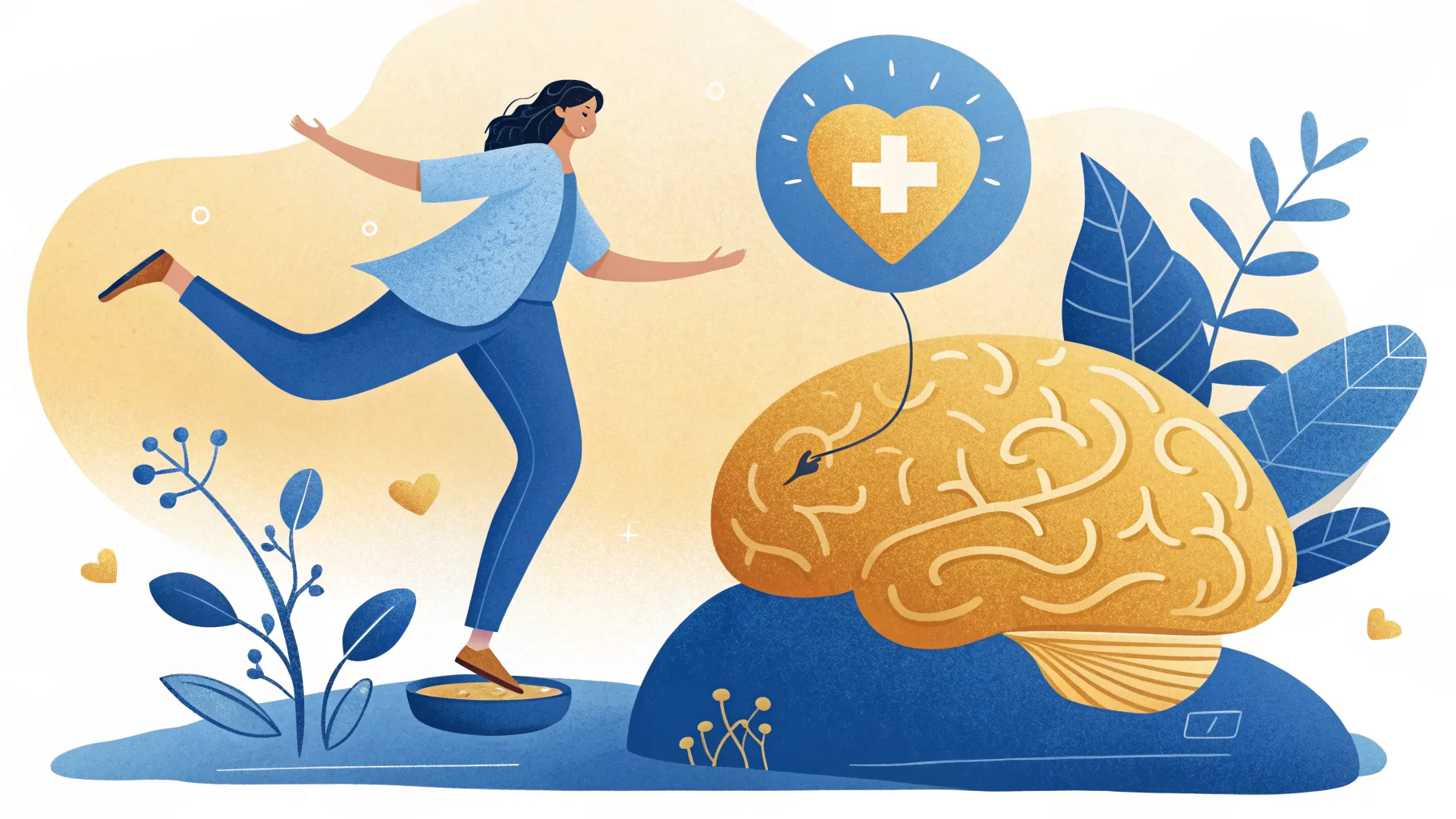
Cerebellum exercises are balance, coordination and timing drills that make the cerebellum work harder: standing on one leg, heel-to-toe walking, finger-to-nose touches, cross-crawls, ball tosses, tapping to a beat, two-handed drawing and balance-board work. They are safe for most people, cost nothing and take about 10 minutes a day at home. For ADHD, the honest answer is that they may help a little, mostly because exercise in general sharpens attention. No well-controlled trial shows that cerebellum-specific drills treat ADHD on their own, so use them alongside proven treatment, not instead of it.
Below are the eight exercises, a simple daily routine, and what the research actually says about cerebellum training, neurofeedback, brain-training apps and meditation for ADHD.
Key takeaways
- The cerebellum coordinates balance, movement and timing, and it is wired into the brain's attention and planning circuits. Brain-imaging studies find cerebellar differences in people with ADHD on average.
- Balance and coordination drills are a low-risk way to work the cerebellum. Keep them hard enough that you wobble or make mistakes.
- Exercise of almost any kind improves attention and executive function in studies of children with ADHD, and a single workout improves impulse control in adults. Evidence for cerebellum-specific programs is thin.
- Neurofeedback and brain-training games have not beaten sham or placebo conditions when the people rating symptoms were blinded. Mindfulness is promising but has been tested mostly in small studies.
- Getting better at a drill is not the same as getting better at life. Judge any of these by changes at work, school and home.
What does the cerebellum have to do with ADHD?
Cerebellum is Latin for "little brain." It sits at the back of your head, where your skull meets your neck, and it is best known for keeping movement smooth, balanced and well timed. It is also connected by closed loops of nerve fibers to many areas of the cerebral cortex, which is why researchers think differences in the cerebellum can affect a wide range of behavior and thinking, not just movement (Stoodley, The Cerebellum, 2016).
In ADHD specifically, a meta-analysis of brain MRI studies, mostly in children, found that cerebellar regions were among the areas showing the largest size differences between people with ADHD and people without it (Valera et al., Biological Psychiatry, 2007).
Two cautions keep that finding in perspective. These are differences in group averages, so a brain scan cannot diagnose ADHD in an individual. And a structural difference does not mean that exercising the cerebellum will reverse ADHD. That is a separate question, and it needs its own evidence, covered further down.
Talk with a board-certified psychiatric provider — from home
TelepsychHealth offers online psychiatry for adults in Arizona, California, Connecticut, Florida, Georgia, Illinois, Michigan, Minnesota, New York, and Texas, and therapy in Illinois, Texas and Florida. We are in-network with major insurance plans, which vary by state.
8 cerebellum exercises you can do at home
Safety first. Do the balance drills next to a counter, wall or sturdy chair you can grab. Skip the eyes-closed and balance-board versions, and check with your doctor first, if you have dizziness, a history of falls, a recent injury, or a neurological or inner-ear condition.
1. Single-leg stand
Stand on one foot for 30 seconds, then switch. Make it harder: turn your head slowly side to side, look up at the ceiling, stand on a folded towel or pillow, or close your eyes (only with support within reach).
2. Heel-to-toe walk
Walk in a straight line, placing the heel of each foot directly against the toes of the other, for 10 to 15 steps. Make it harder: walk backward, or walk the line while counting down from 100 by threes.
3. Finger-to-nose touches
Hold one arm out straight, then touch the tip of your nose with your index finger and return. Alternate hands, 10 times each. Make it harder: have someone hold up a finger as a target that moves after each touch, or speed up while staying accurate.
4. Cross-crawl
March in place, touching each elbow (or hand) to the opposite knee, for 60 seconds. Make it harder: go faster, or touch hand to the opposite heel behind you.
5. Ball toss and catch
Toss a tennis ball from hand to hand in an arc, or bounce it off a wall and catch it, for 1 to 2 minutes. Make it harder: use your non-dominant hand only, stand on one foot while you do it, or graduate to juggling two and then three balls or scarves.
6. Tap to a beat
The cerebellum is central to timing. Set a free metronome app to a steady beat and tap along with one hand, then the other, then alternate. Make it harder: tap a different rhythm with each hand, or clap on every third beat.
7. Two-handed drawing
Hold a pen in each hand. Draw a circle with one hand while drawing a straight up-and-down line with the other, at the same time. Make it harder: switch shapes between hands, or draw a triangle and a square together.
8. Balance board or wobble cushion
Stand on a balance board or inflatable wobble cushion and try to keep it level for 30 to 60 seconds. Make it harder: catch a ball while balancing, or do slow, shallow squats.
A 10-minute daily routine
- Single-leg stand: 30 seconds per side, twice (2 minutes).
- Heel-to-toe walk: forward, then backward (2 minutes).
- Cross-crawl: 1 minute.
- Ball toss: 2 minutes, non-dominant hand for the last 30 seconds.
- Tap to a beat: 2 minutes.
- Two-handed drawing: 1 minute.
Progress to the harder versions as each step gets easy. The drills only stay useful while they are challenging; once you can do something perfectly without thinking, it has become exercise for your legs rather than practice for your brain.
The bigger payoff: activities that combine movement and thinking
Short drills are a starting point. Activities that make you react to a changing situation (tennis, table tennis, basketball, soccer, martial arts, dance) demand balance and timing and split-second decisions. In a network meta-analysis of exercise studies in children and teens with ADHD, these "open-skill" activities produced the largest gains in executive function, while steady aerobic exercise such as running or cycling had the best effect on inattention and hyperactivity (Zhu et al., Frontiers in Public Health, 2023). The authors' practical conclusion is a good one: the best exercise is the one you will keep doing, so pick what you enjoy.
Do cerebellum exercises actually help ADHD?
Here is what the research supports, from strongest to weakest:
- Exercise in general helps. A meta-analysis of 15 randomized trials in 734 children with ADHD found that physical exercise improved attention, executive function and motor skills, though not hyperactivity (Sun et al., Psychiatry Research, 2022). In adults, a 2026 meta-analysis found that a single bout of exercise moderately improved impulse control and slightly reduced core ADHD symptoms; results from longer exercise programs were mixed (Xu et al., Psychology of Sport and Exercise, 2026).
- Balance training has early, small-study support. In a pilot trial of 27 children who were all taking methylphenidate, adding 40 sessions of balance training led to better teacher ratings of attention than medication alone (Feng et al., Frontiers in Psychiatry, 2021). That is encouraging, but it is one small study, in children, as an add-on to medication.
- Commercial "cerebellar" programs have not earned their claims. The best-known one, an exercise program marketed to cure "cerebellar developmental delay" in dyslexia and ADHD, was reviewed by an Oxford developmental psychologist who found its published studies seriously flawed and its claims misleading (Bishop, Journal of Paediatrics and Child Health, 2007).
Bottom line: the drills above are worth doing as part of an active day, especially if you enjoy them. Be skeptical of any program that charges a lot of money and promises to fix ADHD through the cerebellum.
What about neurofeedback, brain-training apps and meditation?
These are often lumped in with cerebellum training. None of them is a cerebellum exercise, and the evidence for each is different.
- Neurofeedback trains you to change your brainwave patterns while watching a screen. A meta-analysis of 13 trials (520 children and teens) found benefits on ratings by people who knew who got the treatment, but no significant benefit when the raters were probably blinded or when neurofeedback was compared with sham training (Cortese et al., JAACAP, 2016). In adults, a triple-blind trial of 118 people found real neurofeedback was no better than sham neurofeedback or a group therapy program; all three groups improved about equally (Schönenberg et al., Lancet Psychiatry, 2017).
- Brain-training games tend to make people better at the kinds of tasks they train. A meta-analysis of 16 trials in 759 children with ADHD found improved scores on working-memory tests, but only limited effects on ADHD symptoms when raters were blinded (Cortese et al., JAACAP, 2015).
- Mindfulness meditation looks more promising. A meta-analysis of 10 studies found moderate reductions in inattention and hyperactivity/impulsivity (Cairncross & Miller, Journal of Attention Disorders, 2020), and a pilot trial in 20 adults found improvements in self- and clinician-rated ADHD symptoms and emotional control compared with a waitlist, though not on lab tests of executive function (Mitchell et al., Journal of Attention Disorders, 2017). The studies are small, and larger trials are needed.
How these exercises fit with proven ADHD treatment
The National Institute of Mental Health lists medication and psychotherapy, such as behavioral therapy and cognitive behavioral therapy, as the common treatments for adults with ADHD, often in combination, with lifestyle changes like more exercise as an addition (NIMH). A practical way to fold in movement:
- Pick one real-life target. Finishing work tasks, getting out the door on time, or fewer lost items. Judge the exercises, and every other treatment, by that target rather than by how good you get at the drills.
- Use movement strategically. Because a single workout can sharpen impulse control for a while afterward, some people schedule a brisk walk, a few minutes of drills or a short game before their hardest focus block of the day.
- Count the side benefits. Regular exercise reliably reduces symptoms of depression and anxiety (Ashdown-Franks et al., Sports Medicine, 2020), both of which commonly travel with ADHD and can make attention worse.
- Get the diagnosis right. Poor sleep, anxiety, depression, substance use and bipolar disorder can all look like ADHD. A careful evaluation sorts out what is driving the symptoms.
ADHD is common in adults: in a 2023 national survey, about 6% of U.S. adults (15.5 million people) reported a current ADHD diagnosis, and roughly half of them were diagnosed in adulthood (Staley et al., MMWR, 2024). If attention problems are getting in the way of your work, relationships or self-esteem, an evaluation is a reasonable next step. Treatment options for ADHD, including which medications can be prescribed through telehealth, differ from state to state; our adult ADHD page explains what is available in the states we serve. For more practical strategies, see non-medication treatments for ADHD, how to focus with ADHD and adult ADHD: diagnosis and treatment.
Frequently asked questions
What exercises stimulate the cerebellum?
Anything that challenges balance, coordination or timing: single-leg stands, heel-to-toe walking, finger-to-nose touches, cross-crawls, ball tossing and juggling, tapping to a metronome, two-handed drawing and balance-board work. Sports and activities such as martial arts, dance, tennis and basketball do the same with added thinking and reaction speed.
Do cerebellum exercises work for ADHD?
They may help modestly, mainly through the general benefits of exercise on attention and executive function. One small pilot trial found that adding balance training to medication improved attention in children, but no large, well-controlled trial shows that cerebellum-specific drills treat ADHD on their own.
What is the best exercise for ADHD?
There is no single best one. In studies of children and teens, activities that require reacting to a changing situation (tennis, basketball, martial arts) produced the biggest gains in executive function, and steady aerobic exercise had the best effect on inattention and hyperactivity. The exercise you enjoy and will keep doing beats the theoretically ideal one you quit.
How can I strengthen my cerebellum?
Practice skills that are a little too hard for you and keep raising the difficulty as they get easier: balance drills, juggling, learning a dance routine, a musical instrument or a new sport. Regular aerobic exercise, good sleep and avoiding heavy alcohol use also support overall brain health. If you have new problems with balance, coordination or slurred speech, see a doctor promptly rather than trying to exercise it away.
Can cerebellum exercises replace ADHD medication?
No. They are a reasonable add-on, not a substitute for evidence-based treatment. If you take ADHD medication, keep taking it as prescribed and talk with your prescriber before making any change.
Are cerebellum exercises useful for adults, or just children?
Most of the research is in children, but the exercises themselves are just as safe for adults, and adult studies show that exercise can improve impulse control in the short term. Adults often get the most out of a sport, class or dance style they enjoy, because it is easier to stick with.
Final thoughts
Cerebellum exercises are a cheap, low-risk way to build more movement into your day, and movement is good for attention, mood and sleep. Use them as one part of a broader plan, be wary of expensive programs promising a cure, and measure success by what changes in your daily life.
Talk with a board-certified psychiatric provider — from home
TelepsychHealth offers online psychiatry for adults in Arizona, California, Connecticut, Florida, Georgia, Illinois, Michigan, Minnesota, New York, and Texas, and therapy in Illinois, Texas and Florida. We are in-network with major insurance plans, which vary by state.
Founder and Medical Director of TelepsychHealth. Board-certified addiction psychiatrist caring for patients in ten states by secure video.